
Industry-news
The Impact of Geometric Aberration on Optical System Imaging
When we admire a photograph or observe an image through a lens, we sometimes notice blurriness. One of the reasons for this phenomenon is geometric aberration. The presence of geometric aberration not only reduces image sharpness and contrast but also causes image distortion and geometric deformation, directly affecting the performance of optical imaging systems. A deep understanding and effective control of geometric aberration are essential, whether for the sharp imaging pursued by professional photographers or the manufacturing of lenses.
What is Geometric Aberration?
In an ideal optical system, all light rays would converge at a single focal point, forming a perfect image. However, in real systems, the rays emitted from an object point do not converge to an ideal image point after passing through the optical system but instead form a blur spot. For monochromatic light, there are five distinct aberrations: spherical aberration, coma, astigmatism, field curvature, and distortion, collectively known as monochromatic aberrations.
Yet, most practical optical systems image white light or polychromatic light. Because the refractive index of optical media varies for different wavelengths (colors), the imaging position and size differ for various colors. This difference is known as chromatic aberration. Since all the aforementioned aberrations are discussed based on geometric optics, they are collectively termed geometric aberrations.
Spherical Aberration
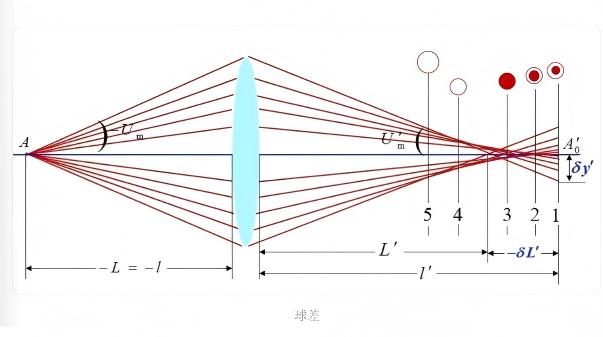
Spherical aberration is an on-axis point aberration inherent to lenses. When light rays from an on-axis object point pass through a lens to form an image, rays with different aperture angles are refracted to different degrees, causing them to focus at different axial positions on the image side.
Effect: It leads to a decrease in image sharpness. On the image plane, a point source forms a circular blur spot instead of a sharp point. If a movable screen is placed on the image side for observation, the image transitions from a blurred circle to a pattern with a bright central spot surrounded by rings, but no position where all rays perfectly converge can be found.
· 
Coma
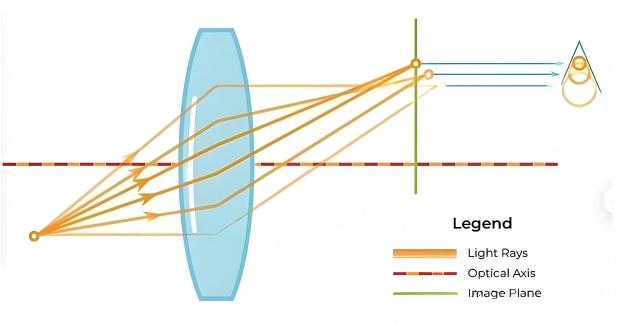
Coma is an off-axis point aberration. It occurs because the beam from an off-axis object point loses symmetry on the image side, skewing to the same side of the principal ray and failing to converge at the intersection of the principal ray and the image plane.
·
Effect: Coma causes a point source to image as a comet-shaped flare—a bright head with a gradually expanding, dimming tail. This aberration blurs details at the image edges. Particularly in astronomical observations, it causes directional trailing of point sources like stars.
Astigmatism
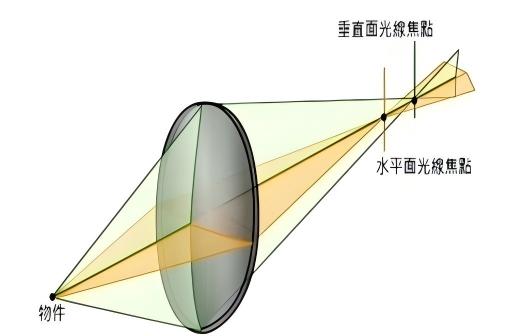
Astigmatism refers to the phenomenon where the tangential (meridional) image point and the sagittal image point of a beam from an off-axis object point do not coincide after passing through the optical system.
Effect: It prevents light from a single object point from converging into a sharp point, leading to a blurred or stretched/distorted image.
Field Curvature
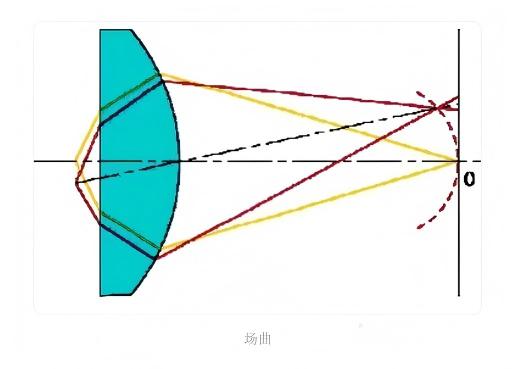
Field curvature, or curvature of field, is the phenomenon where the image formed by an object through an optical system does not coincide with the ideal image plane but deviates from it.
·
Effect: It causes the center and edges of the frame to be in focus at different distances, reducing overall image quality across the field.
Distortion
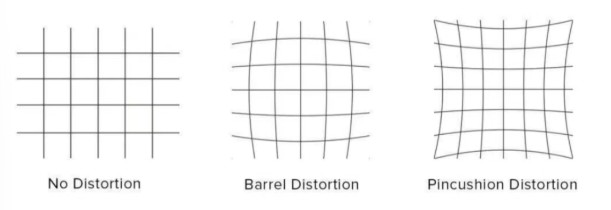
Distortion is an aberration of the chief ray. In a real optical system, the image magnification varies with the field of view, causing the image to deform. This variation disrupts the original geometric proportions, leading to image twisting or deformation.
Effect: Distortion does not affect image sharpness but causes geometric warping. It is divided into barrel distortion (negative distortion, image appears "puffed") and pincushion distortion (positive distortion, image appears "pinched"). In architectural photography, distortion can make building lines appear tilted or curved.
Chromatic Aberration
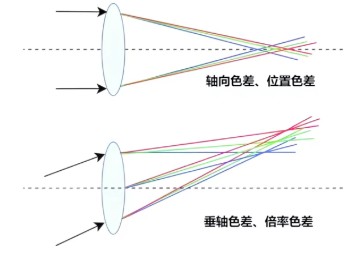
Chromatic aberration occurs because optical materials have different refractive indices for different wavelengths of light, causing light of different colors to image at different positions and sizes. It is divided into longitudinal chromatic aberration (axial) and lateral chromatic aberration (transverse).
Effect: Chromatic aberration produces colored fringes at high-contrast edges, reducing color fidelity and image sharpness. Longitudinal chromatic aberration causes foci of different wavelengths to lie at different positions along the axis, while lateral chromatic aberration results in different image heights for different wavelengths on the image plane.
· 
All the parameters mentioned above can be measured with our equipment. Thank you for reading. We hope this article on geometric aberration provides inspiration and proves helpful for your precision measurement work.
